
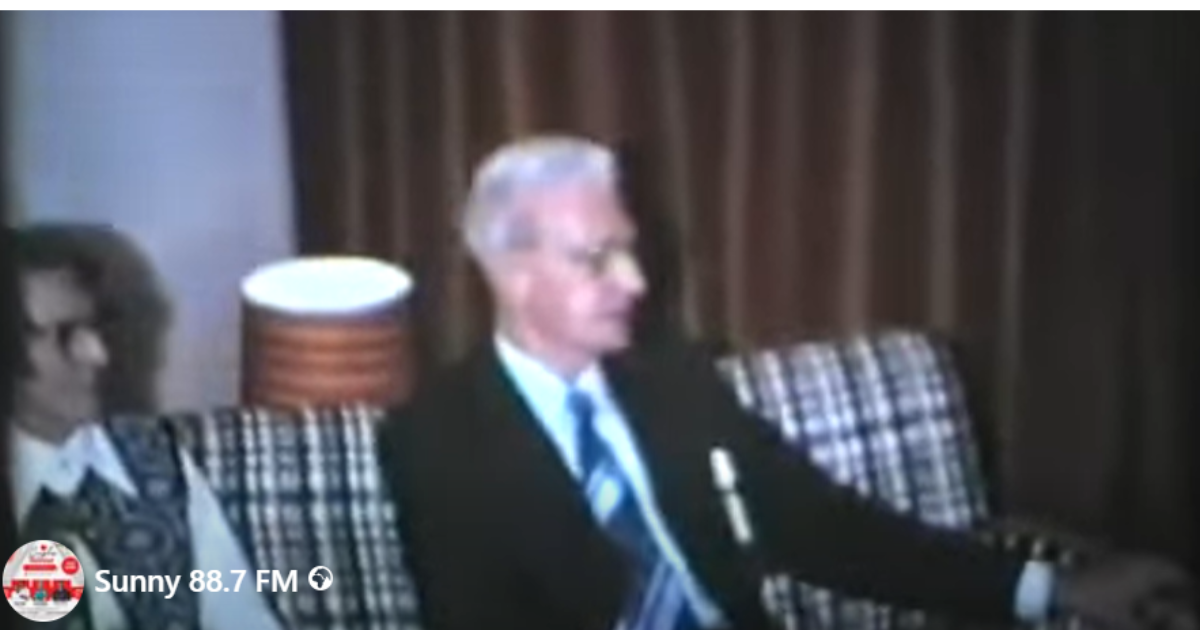
An archival interview with Pastor James McKeown and his wife, Sophia, offers a fascinating first-hand account of the humble beginnings of what would become The Church of Pentecost, beginning with open-air preaching, children singing choruses and Ghanaian women carrying the Gospel from town to town.
Long before The Church of Pentecost became one of Ghana's most influential Christian denominations, there were no large auditoriums, thousands of assemblies or huge conventions.
According to an archival interview with Pastor James McKeown and his wife, Sophia McKeown, when they arrived in the then Gold Coast in 1937, they had virtually nothing with which to begin.
"We had no church, we had no house, we had no people," Mrs McKeown recalled.
So they went outside and started preaching in the open air.
The Journey to the Gold Coast
James McKeown traced his Christian journey to his youth. At 19, he attended a Pentecostal meeting where a sermon about Jesus Christ profoundly affected him. He was later baptised in water and said he subsequently experienced the baptism of the Holy Spirit.
Years later, while worshipping with the Apostolic Church, a prophecy came in 1935 that he and his wife should go to West Africa, specifically the Gold Coast.
McKeown admitted that he initially hesitated because he believed there were better men for the task. But the call also connected with a childhood dream he had once carried, to become a missionary in Africa.
On March 2, 1937, he arrived in the Gold Coast to begin missionary work. His wife followed six months later.
It Started With Children
Mrs McKeown's recollection of those early days is particularly striking.
With no established congregation, they preached outdoors.
Children began gathering around them and were taught a chorus. As the children became interested in the singing and preaching, women also started coming.
At first, according to Mrs McKeown, their audiences consisted almost entirely of women, with perhaps only one or two men attending.
Then something unexpected happened.
The husbands began noticing changes in their wives.
Mrs McKeown recalled that as women embraced the Christian faith, changes in their behaviour and family lives attracted their husbands' attention. Curious about what was responsible, some of the men began attending the meetings themselves.
The Women Who Carried the Gospel
Perhaps one of the most remarkable revelations in the interview is the crucial role played by Ghanaian women in spreading the early Pentecostal message.
Many of the women were traders who travelled from town to town selling cloth.
Mrs McKeown described how a converted trader might sit at the market singing while selling her goods. Another woman would notice her joy and ask what made her so happy.
Her answer was simple: Jesus had changed her life.
She would then invite the other woman to attend a meeting and hear more about Christ.
"That was the beginning of our work," Mrs McKeown recalled.
James McKeown later made the point even more explicitly, saying it was Africans, especially women, who propagated the Gospel through their testimonies and everyday interactions.
It is a remarkable picture of evangelism: no sophisticated media campaign, no elaborate buildings and no massive organisation, just ordinary people telling others what they believed Jesus had done in their lives.
"God Is Here"
McKeown said his original commission was straightforward: preach Jesus Christ.
He recalled discovering that the people he encountered already acknowledged God, but his message sought to present God not as distant but as personally accessible through Jesus Christ.
"I learned that the Africans always said God is there," he recalled. "I had to teach them by the grace of God, God is here."
As converts shared their experiences with others, new groups of believers emerged and eventually formed assemblies.
Young Ghanaian men began taking responsibility for teaching and building these congregations, allowing the movement to expand without missionaries being present everywhere.
From 200 People to Tens of Thousands
The growth was extraordinary.
McKeown recalled that an early convention attracted about 200 people. Later, gatherings grew to around 7,000, and eventually he spoke of conventions drawing approximately 40,000 worshippers.
And these were not gatherings inside elaborate church buildings.
McKeown described constructing simple meeting places using bamboo poles and palm branches for roofing, with boards placed over cement blocks to provide seating.
Meetings during major conventions could begin as early as 4:00 a.m., with another session at 9:00 a.m. and an evening meeting from around 5:00 p.m. to 9:00 p.m.
Yet the crowds continued to grow.
When people wondered what was attracting such numbers, the music, tambourines or hand-clapping, McKeown's answer was unequivocal:
The attraction, he said, was Jesus Christ.
When Ghana's Head of State Came to Church
By the time of the interview, the movement had grown to the point where McKeown recalled an Easter gathering estimated at 50,000 people.
Ghana's Head of State was invited and attended with some of his ministers, taking his place among the enormous congregation.
For McKeown, this demonstrated how far the movement had travelled from those first open-air meetings.
He said churches that had initially looked down on the movement were beginning to recognise that something significant was happening in what had become known as The Church of Pentecost.
How the Name "The Church of Pentecost" Was Chosen
The interview also contains McKeown's account of how the church received its name.
As the organisation grew, the question arose: What should the church be called?
McKeown said he typed several possible names on a piece of paper and presented them to the African pastors.
When they reached "The Church of Pentecost," their response was immediate.
"That's it."
McKeown was emphatic about one detail:
"They decided, not I decided."
It is a small but historically significant detail about the identity of a church that would eventually spread far beyond Ghana.
A Church That Would Support Itself
Another principle established in the early years concerned money.
McKeown said they deliberately decided not to solicit funds from abroad to sustain the work. His conviction was that if the work was genuinely of God, God would provide for it.
Instead of missionaries continually asking people for money, he said believers began giving voluntarily as their commitment to the faith deepened.
Even as the movement expanded and church buildings became necessary, McKeown remained proud that they were not appealing abroad for money to construct them.
1,300 Churches, and Still Growing
By the period captured in the interview, McKeown reported that The Church of Pentecost had grown to approximately 1,300 churches in Ghana, with additional congregations in Togo, Dahomey (present-day Benin) and Upper Volta, now Burkina Faso.
Not every congregation had its own pastor. Elders, deacons and presiding elders played major roles in local leadership, while pastors could supervise several churches.
Crucially, McKeown said future ministers emerged from the local assemblies themselves, gaining experience within the congregations before being called into full-time ministry. Women and young men were also organised and trained for evangelistic work.
The church was also embracing the media of its time. McKeown spoke about two radio broadcasts each week, one in English and another in a local language, as well as a magazine distributed free throughout Ghana.
From a Chorus in the Open Air to a National Movement
Looking back at the testimony of James and Sophia McKeown, perhaps the most compelling aspect of the story is how ordinary its beginning appears.
There was no church.
No house.
No congregation.
They went into the open air.
Children came.
They taught them a chorus.
Women followed.
The women encountered the Christian message and told other women. Husbands noticed changes and came to investigate. Ghanaian believers began preaching themselves. Assemblies formed. Local leaders emerged.
And the movement kept spreading.
The archival interview therefore preserves more than the memories of two missionaries. It captures a remarkable chapter in Ghana's Christian history and highlights something easily overlooked when looking at The Church of Pentecost today:
The movement that would eventually reach millions began with a remarkably simple strategy, people whose lives had been changed telling other people about Jesus.